
Smart Helmet Reminder Using ESP8266
The bike won’t "start" until the helmet is on, and a buzzer nags until it is.
Built and tested by Shahan Fathima K · Industrial Robotics Institute
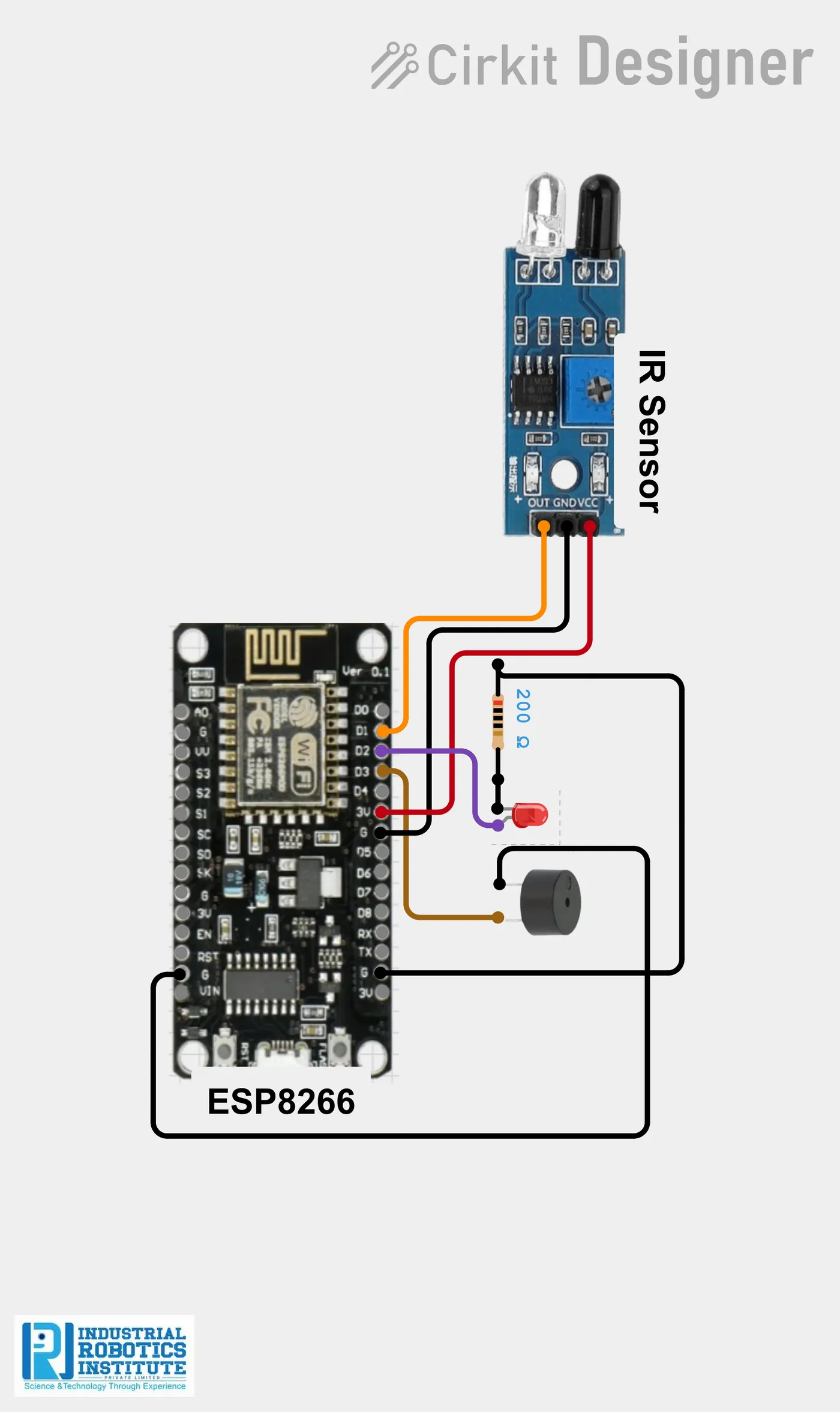
What is the Smart Helmet Reminder?
A road-safety system that checks the rider is wearing a helmet. An IR sensor inside the helmet detects when it is worn. Only then does the ESP8266 switch on the LED or relay that stands in for the bike’s ignition; without the helmet, the ignition stays off and the buzzer sounds.
How it works
- The IR sensor inside the helmet detects the rider’s head.
- Helmet worn: the LED/relay (ignition) turns on and the buzzer stays off.
- Helmet not worn: the ignition stays off and the buzzer warns the rider.
- The ESP8266 checks five times a second.
Parts list
| Component | Qty |
|---|---|
| ESP8266 NodeMCU | 1 |
| IR Sensor Module | 1 |
| Buzzer | 1 |
| LED or Relay Module | 1 |
| Jumper Wires | As needed |
| Power Supply | 1 |
Software
- Arduino IDE
Wiring and connections
| From | Connect to |
|---|---|
| IR sensor VCC | 3.3V |
| IR sensor GND | GND |
| IR sensor OUT | D1 |
| LED / Relay IN | D2 |
| Relay VCC / GND | 5V (VIN) / GND |
| Buzzer + | D3 |
| Buzzer − | GND |
How to build the Smart Helmet Reminder
- Fix the IR sensor inside the helmet so it faces the wearer’s head.
- Connect the sensor output to D1.
- Connect an LED (or relay for a real ignition circuit) to D2, and the buzzer to D3.
- Upload the code from the Arduino IDE.
- Put the helmet on and off to check that the LED and buzzer swap.
Smart Helmet Reminder code
Complete, tested Arduino C++ code for this project. Copy it into Arduino IDE and upload it to the ESP8266 NodeMCU.
#define sensorPin D1
#define ledPin    D2
#define buzzer    D3

void setup()
{
  pinMode(sensorPin, INPUT);
  pinMode(ledPin, OUTPUT);
  pinMode(buzzer, OUTPUT);
}

void loop()
{
  int helmetStatus = digitalRead(sensorPin);

  if (helmetStatus == HIGH)       // helmet worn
  {
    digitalWrite(ledPin, HIGH);   // ignition allowed
    digitalWrite(buzzer, LOW);
  }
  else                            // helmet not worn
  {
    digitalWrite(ledPin, LOW);
    digitalWrite(buzzer, HIGH);
  }

  delay(200);
}
Real-world uses
- Two-wheeler safety
- Delivery rider fleets
- Road safety awareness
- Smart vehicle models
Frequently asked questions
What is a Smart Helmet Reminder?
A road-safety system that checks the rider is wearing a helmet. An IR sensor inside the helmet detects when it is worn.
What components are needed for the Smart Helmet Reminder?
You need: ESP8266 NodeMCU (1), IR Sensor Module (1), Buzzer (1), LED or Relay Module (1), Jumper Wires, Power Supply (1). Software: Arduino IDE.
Is the Smart Helmet Reminder project good for beginners?
Yes. It is rated beginner and takes about 1–2 hours to build, using the ESP8266 NodeMCU. The guide on this page explains every connection and step.
Where can I get the code for the Smart Helmet Reminder?
The complete, tested Arduino C++ code is free on this page. Copy it into Arduino IDE and upload it to the board.
Can I buy a kit for the Smart Helmet Reminder?
Yes. IRI sells a kit with the parts for this project (PRJ-052). Message IRI on WhatsApp at +91 86060 82634 for the kit price and delivery details.