Degree students hear the same advice from every recruiter: show what you can build. A value added course in robotics or IoT is one of the most direct ways to do that. Colleges looking for an add-on course for BCA students, a skill course for BSc students, or an IoT course for college students can run a short, hands-on program on campus without building a lab first. This article explains how a 30-hour or 60-hour add-on fits a semester, what students build, and how colleges organise it.
Why degree students need a hands-on add-on course
Many BCA, MCA and BSc students learn programming and electronics theory well. Fewer get to connect a sensor, read real data, control a motor or debug a system that fails in the real world. Employers and higher-study interviewers notice that gap.
A practical add-on course fills it in a few focused days. Students leave with working projects, photos and code they can show, and a clearer idea of which field they want to pursue.
Who these courses are for
IRI’s add-on courses are designed for students of BCA, MCA, BSc and MSc Computer Science, Electronics and Physics. They work especially well for final-year UG and PG students who are planning projects, internships or job applications.
Three course tracks
Hands-On Robotics & Automation
Students work with the ESP32, a robotic arm, PLC-style automation logic and ROS2, the Robot Operating System used widely in research and industry. The track builds toward an AI vision sorting cell, where a camera identifies objects and the system sorts them.
Hands-On IoT & Industrial IoT
Students build connected systems with the ESP32, send data over MQTT, create flows and dashboards in Node-RED, store data in Firebase and talk to industrial devices over Modbus RS-485. This is a strong fit for computer science students who want to see where software meets hardware.
Hands-On Electronics & Embedded Systems
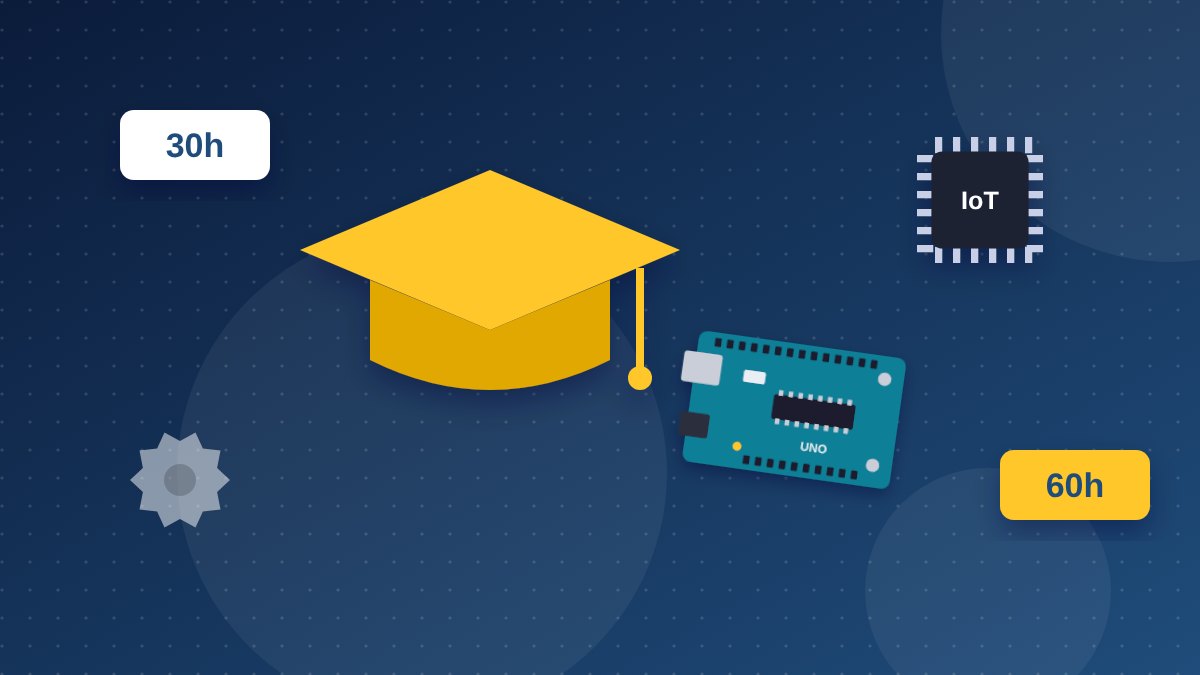
Students start on the breadboard, program the Arduino Uno in Embedded C, design a circuit board in KiCad and learn to solder. Electronics and physics students often choose this track to strengthen their core lab skills.
Value added course in robotics: 30-hour vs 60-hour
| Feature | 30-hour version | 60-hour version |
|---|---|---|
| Duration | 5 days | 10 days |
| Schedule | One continuous 5-day block | Two 5-day blocks |
| Depth | Core skills and guided projects | Core skills plus advanced topics and more projects |
| Hands-on share | 85% | 85% |
| Capstone | Team capstone project | Team capstone project |
| Certificate | Yes | Yes |
Across the tracks and versions, students complete from 16+ up to 26 projects, plus the team capstone.
How the add-on fits a semester
Colleges usually worry about timetable space. A block format makes planning simpler, because the course does not need a weekly slot across the whole term.
- 30-hour version: schedule the five days in a lighter week, such as the start of a semester, after internal exams, or just before a project phase begins.
- 60-hour version: split the two 5-day blocks with a gap between them. For example, run the first block early in the semester and the second block later, or place one block in each semester. Students practise and plan their capstone ideas in between.
- Final-year students: running the course before the main project period gives them ideas and skills they can use straight away.
Because it is an add-on, the course sits alongside the university syllabus. Colleges decide how to record participation within their own rules.
What students build
Projects are hands-on and build in difficulty. Typical examples by track:
- Robotics & Automation: Wi-Fi controlled motor systems with the ESP32, pick-and-place routines on a robotic arm, sequence logic in the style of a PLC, and a camera-based sorting cell.
- IoT & Industrial IoT: a sensor node that publishes readings over MQTT, a Node-RED dashboard with live charts and alerts, a Firebase data logger, and reading values from a Modbus RS-485 device.
- Electronics & Embedded: breadboard circuits, Arduino Uno programs in Embedded C, a PCB layout in KiCad and a soldered working board.
Every batch ends with a team capstone, where students combine what they learned into one working system and present it.
How colleges run an IoT course for college students
- Choose the track and version. Match it to the department: IoT for computer science, Electronics & Embedded for electronics and physics, Robotics & Automation for mixed groups.
- Fix the batch. Each batch can have 30 to 100 students.
- Book the dates. Pick a 5-day block, or two blocks for the 60-hour version.
- Arrange the room. Provide a hall or lab with tables, seating and power points. IRI brings all the kits, so the college does not need to buy equipment.
- Run the course. IRI trainers lead the sessions, and 85% of the time goes to hands-on work.
- Close with the capstone and certificates. Teams demonstrate their projects, and students receive a certificate.
Benefits for students and colleges
- Students gain practical skills and a portfolio of working projects.
- Final-year students get project ideas and a head start on implementation.
- Departments add a practical, industry-oriented program without setting up new labs.
- Faculty can observe how hands-on sessions run and carry ideas into regular labs.
Key takeaways
- Three tracks: Robotics & Automation, IoT & Industrial IoT, and Electronics & Embedded Systems.
- Choose 30 hours over 5 days, or 60 hours over two 5-day blocks.
- Courses are 85% hands-on, with 16+ to 26 projects and a team capstone.
- IRI brings all kits, and batches run from 30 to 100 students.
- Block scheduling makes the course easy to fit into a semester.
Bring an IRI add-on course to your college
Industrial Robotics Institute (IRI) has trained more than 60,000 learners and runs an in-house industrial production unit, so its courses reflect how real systems are built. To plan a 30-hour or 60-hour add-on course for your BCA, MCA, BSc or MSc students, call 8606082634 or email inrobos@gmail.com.
30-hour or 60-hour hands-on Robotics, IoT and Embedded courses. IRI brings all kits.
Call 8606082634 · inrobos@gmail.com
Frequently asked questions
Does the college need to buy kits or set up a lab?
No. IRI brings all the kits. The college provides a hall or lab with tables, seating and power points.
How many students can join one batch?
Each batch can have 30 to 100 students. The course is 85% hands-on and ends with a team capstone project.
What is the difference between the 30-hour and 60-hour versions?
The 30-hour version runs over 5 days. The 60-hour version runs over 10 days in two 5-day blocks and covers more topics and projects.